


Honestly? Every morning I just stare at the mirror and ask myself “is it actually getting worse, or am I imagining it?” I never really know.
BACKGROUND
Bridging the gap between clinical data and daily habits.
As awareness of personal wellness grows, consumers are demanding more scientific approaches to hair care. However, the market currently forces a compromise: users either rely on blind guesswork or face overly complex, clinical-grade diagnostic tools that lack everyday usability.
The opportunity was clear: the market lacked an accessible, personalized ecosystem. We needed to build a 0-to-1 product that not only leverages AI to reveal invisible hair health but also translates that complex data into intuitive, actionable daily habits for the everyday user.
Industry
AI
Health Care
Prediction Market
Platform
Mobile
PC
Tablet
Main Tool
Figma
Adobe Suites
Lean UX
Deliverable
UX Research
Quantitative & qualitative research, user flow, edge case mapping, data visualization strategy, usability testing, competitor analysis.
UI/UX Design
Wireframe, high-fidelity prototype, responsive design, typography & color hierarchy, design system integration, state management.
Tech Handoff
Design-to-engineering handoff, edge case handling, user acceptance testing (UAT).
Discover.
MARKET ANALYSIS
An industry waking up to the hair and scalp.
The global hair-care market is on track to surpass $112B by 2027, but the real signal isn't the size — it's who's worrying.
In Asia alone, more than 250 million adults now report some form of hair thinning, and over 60% of them are under thirty. Search interest in "scalp care" and "hair health" has roughly tripled in five years, marking a quiet shift from styling rituals to long-term wellness. The opportunity isn't another shampoo — it's a way for people to read their own hair.
COMPETITIVE LANDSCAPE
Diagnosis is loud. Daily care is silent.
Existing tools sit at two extremes. Clinical trichoscopes deliver lab-grade accuracy, but they live in salons and dermatology clinics — bulky devices, $150–$300 per session, with reports written in jargon most users can't parse. At-home alternatives swing the other way: vanity-grade scores, prettier UI, but little science underneath, and nothing that connects today's reading to tomorrow's routine.
The middle — daily, trustworthy, legible — is where Haircosys lives.
USER INTERVIEWS
People aren't asking for a diagnosis. They're asking for a feedback loop.
I ran ten 60-minute in-depth interviews with users aged 22–38, each of whom had tried at least one hair-health product in the past year. Three themes surfaced again and again. First, they didn't trust their own mirror — "Is it getting worse, or am I imagining it?" Second, they couldn't translate product claims into a routine they actually believed in. Third, most gave up within four weeks, because nothing told them whether anything was working. What they wanted wasn't more diagnosis. It was a small, repeatable signal — a way to feel progress, not just hope for it.
The bottle says “strengthens follicles”. Okay— but strengthens what, by how much, by when? I have no way to tell if any of it is actually working.
I bought the whole routine, used it for three weeks, and quit. Nothing told me anything was changing. So I just… stopped.
Define.
THE OPPORTUNITY
Designed for the in-between user.
Between the clinic-bound trichoscope and the bathroom-shelf shampoo sits a user no product has properly served: the informed-but-uncertain.
They're 22–38, mostly urban, increasingly cross-gender — readers of ingredient lists, followers of scalp-care creators, skeptical of marketing copy yet quietly anxious about what they see in the mirror. They don't want a prescription. They want a small, daily reading they can act on.
Haircosys is built for them: a phone-native AI scan that turns hair health into a number they can track, a ritual they can keep, and a habit they can feel.

VALUE PROPOSITION
From a number, to a ritual, to a habit.
Haircosys closes a loop the industry left open. Each scan reads sebum, scalp tone, strand quality and follicle density into a single Hair Score and a five-axis chart. That score is paired with Today's Ritual — a small, contextual routine drawn from the user's own data, not a generic regimen.
Over time, the rituals stack into habits, the habits move the score, and the score in turn re-shapes tomorrow's ritual. The product isn't the scan. It's the loop the scan starts.

PRODUCT PRINCIPLES
Three rules that keep the product honest.
Three principles, written before the first wireframe, governed every later decision — from radar geometry to copy tone to product card density.
01 — Numbers people can feel.
Every metric must tie back to a sensation, an action, or a memory. If a user can't act on it, we don't surface it.
02 — A ritual, not a regimen.
We design for daily lightness, not clinical compliance. The product asks for sixty seconds, not sixty minutes.
03 — Beauty without losing rigor.
Editorial calm is the wrapper; the science underneath stays uncompromised. Warmth is not a substitute for accuracy — it's the delivery vehicle for it.
Translate.
SHAPE MEMORY
Designing for patterns, not just numbers.
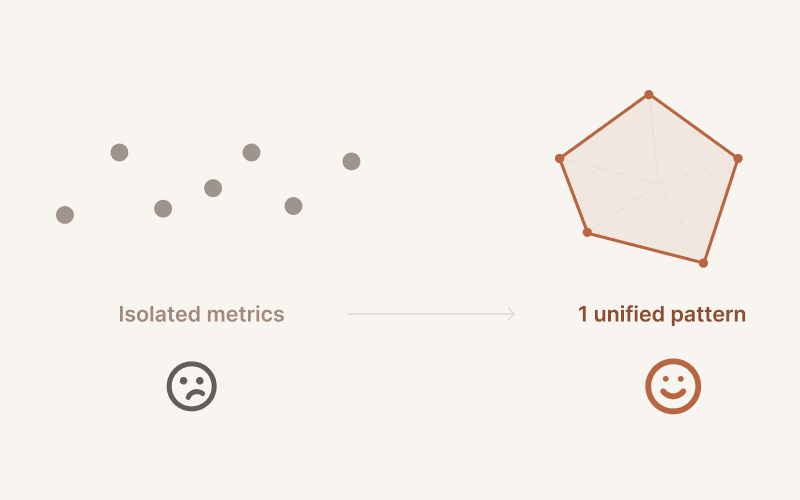
Hair health is a holistic ecosystem. Using lists or bar charts scatters the user's attention across isolated metrics.
To lower cognitive load, I designed a five-axis radar chart that translates complex data into a unique polygon. The human brain processes and recalls spatial shapes far more effortlessly than raw numbers. Users don't need to memorize exact scores; they simply observe whether their unique shape is expanding (improving) or denting (needing attention).
CONTEXTUALIZING DATA
From raw data to relatable context.
Raw AI outputs, like "0.06mm strand thickness," leave users confused and anxious. Without a frame of reference, absolute values feel like clinical diagnoses rather than helpful insights.
I shifted the verdict from absolute numbers to relative comparisons. By stating a user is "Healthier than x% of similar profiles," I provide a realistic baseline based on age and genetics. This contextualization transforms cold machine data into a relatable benchmark, effectively reducing health anxiety and setting realistic expectations.

EMOTIONAL CONTINUITY
Measuring progress, not perfection.
I discarded traditional A-F grading systems early on. Letter grades carry a heavy psychological weight—feeling more like a final judgment than a helpful insight—and the gaps between grades are too large to show short-term progress.
Instead, I introduced a 0–100 continuous score. This granular approach allows the interface to capture micro-wins. By highlighting a "+2" or "+3" improvement, I provide users with the immediate emotional reward they need to keep trusting the AI and stick to their hair care rituals.

HABIT-CENTRIC DESIGN
Selling a routine, not just a product.
When an AI scan immediately recommends a shampoo, it feels less like a clinical tool and more like an e-commerce trap. To avoid this, I restructured the user journey to prioritize habit-building over instant transactions.
Nesting product recommendations within a "Ritual" framework offers actionable, non-commercial advice. Products are introduced later, naturally aligning with specific "watch areas." This intentional friction preserves the AI's neutrality and turns a transactional moment into a habit-building experience.

Build.
INFORMATION ARCHITECTURE
Structuring the awareness-to-action loop.
For a 0-to-1 product, the biggest trap is feature bloat. I stripped the foundation down to four essential tabs, treating them not merely as navigational buckets, but as a continuous lifecycle of habit formation.
Home is the daily control center—minimizing cognitive load by focusing purely on immediate actions: the quick AI scan and today's ritual checklist. Explore acts as the solution hub, closing the commercial loop by turning AI insights into personalized product and content recommendations. Records is the trust-builder, visualizing historical data and progress to drive long-term retention. Finally, Profile quietly handles device and account management, kept intentionally out of the way.

CORE FLOWS
Choreographing the habit loop.
To prevent Haircosys from becoming a one-time novelty, I orchestrated three distinct flows designed to turn AI data into a lasting routine.
The journey begins with the First-time scan, which builds immediate trust through progressive disclosure. By guiding users from lighting calibration to AI processing animations, it establishes credibility before revealing their baseline report.
Once onboarded, the Daily check-in strips away all friction. It bypasses tutorials in favor of a "Quick Compare" view, using micro-progress to motivate returning users.
Crucially, the Recommendation-to-Ritual loop closes the gap between insight and action. When a user adopts a recommended product, its specific routine is automatically injected into their Home calendar—seamlessly transforming a one-off purchase into an actionable daily habit.

DESIGN SYSTEM
Editorial calm over clinical sterility.
Most AI health tools rely on clinical blues and dense dashboards that inadvertently induce "patient anxiety." For Haircosys, I established a visual language that balances scientific rigor with the welcoming elegance of a high-end beauty magazine.
To ensure a scalable 0-to-1 build, I standardized a library of purposeful components: intuitive data visualizations, lightweight action cards for daily rituals, and warm, illustration-driven empty states that gently guide users toward their first scan rather than leaving them at a dead end.
Prototype.
CORE EXPERIENCE
A seamless experience of scan, learn, and act.
The architecture of Haircosys is designed to lower the barrier to entry while maximizing user engagement. From a personalized Home dashboard that anchors the daily routine, to a frictionless AI-scan interface that guides users through the capture process, and an Explore feed that bridges their current hair state with targeted product solutions.

AI REPORT & TRACKING
From complex diagnostics to clear directions.
The biggest pitfall in AI-driven health tools is cognitive overload. Users don't need raw data; they need meaning. The AI Report distills thousands of pixel-level data points into a single, digestible health score, paired with intuitive visual progress tracking.
By translating clinical jargon into plain-language insights and actionable next steps, the Records feature transforms a static, intimidating medical-style result into a continuous, motivating journey. It tells the user exactly where they stand today, and exactly what to do tomorrow.

Impact and reflection.
Making the Invisible Visible
Transforming complex AI diagnostics into actionable, everyday hair care habits.
USER IMPACT
From guesswork to data-driven habits
Traditional hair care often relies on blind trial and error. Haircosys disrupts this limitation by translating microscopic AI scalp analysis into intuitive, actionable insights, enabling users to truly understand their hair health.
Successfully launched across 10+ countries with a >95% user satisfaction rate, this shift transforms hair anxiety into empowerment. Users can now confidently build and track their personalized care routines based on legible, high-confidence data.
BUSINESS VALUE
Driving subscriptions & e-commerce conversion
By integrating AI diagnostics with a continuous habit-tracking loop, we created a dynamic ecosystem that serves as a powerful retention hook. This sustained engagement is the primary driver for our premium subscription renewals.
Furthermore, seamlessly linking users' specific health data to targeted physical product recommendations significantly shortens the purchasing decision process. This personalized, data-backed approach builds trust, directly boosting both conversion rates and Average Order Value (AOV).
DESIGN REFLECTION
Navigating 0-1 trade-offs & humanizing AI
Steering a product from a conceptual idea to a global launch required strategic trade-offs, constantly balancing visionary features with MVP technical constraints and business goals.
The core design challenge was abstracting complex, clinical-grade AI parameters into an accessible interface. By utilizing progressive disclosure, intuitive visual metaphors, and empathetic copywriting, I successfully prevented cognitive overload—ensuring non-expert users could easily "read" their health and bridging the gap between raw machine data and human-centric design.